Weeds in the Wasteland: How Solarpunk Kids Are Turning Forgotten Cities Into Living Blueprints
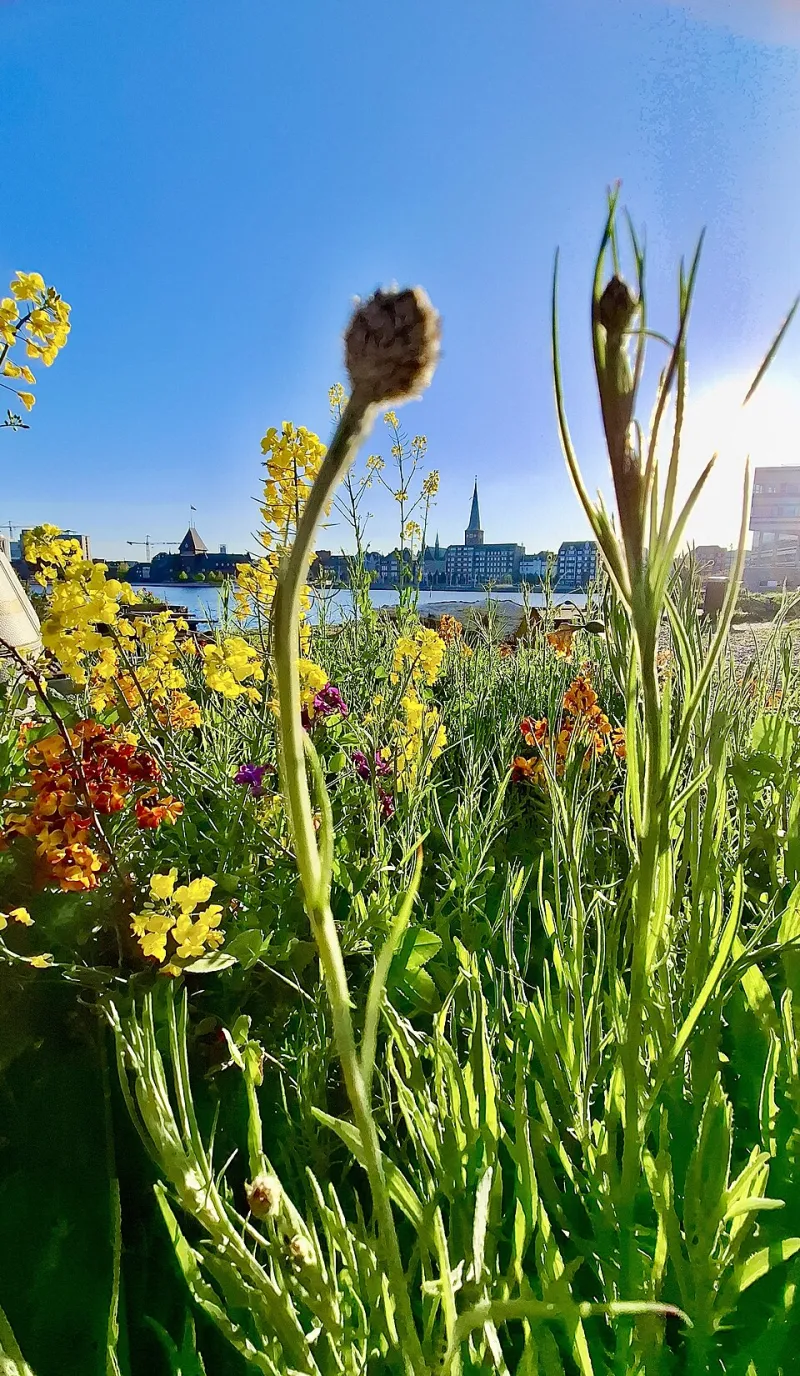
Photo: Ciara Ní Riain, CC BY-SA 4.0, via Wikimedia Commons
There's a greenhouse growing inside a decommissioned Detroit bus depot. Tomatoes climb rusted support beams. Solar panels — secondhand, mismatched, beautiful — angle toward a hole someone cut into the roof on purpose. On the far wall, a mural of a city that doesn't exist yet stretches floor to ceiling: towers wrapped in vines, streets full of bikes, people who look genuinely, unironically happy.
This isn't a movie set. It's Tuesday.
The people tending this place are mostly in their twenties. Some have degrees they can't afford to use. Some never finished school at all. What they share is a refusal — quiet but absolute — to accept that the world has to keep looking the way it does.
Welcome to solarpunk. Or rather, welcome to what solarpunk actually is when it climbs down off Tumblr and gets its hands dirty.
What Even Is Solarpunk, Though?
If you've heard the word at all, you've probably seen the aesthetic: lush greenery cascading over solar-paneled rooftops, diverse communities gathered in sun-drenched plazas, fashion that somehow looks both ancient and a hundred years ahead of schedule. It's gorgeous. It's also, critics like to point out, dangerously close to fantasy.
But solarpunk was never just a vibe. It started as a literary movement in the early 2010s — a direct rebuttal to the grimdark, corporate-dystopia futures that science fiction had basically made its whole personality. Writers like Becky Chambers and anthologies like Sunvault asked a genuinely radical question: what if we imagined futures where people actually figured it out? Where the response to climate collapse wasn't bunkers and billionaires, but community, creativity, and mutual care?
From there, the ideas leaked out of fiction and into something messier and more real. Community gardens. Repair cafes. Collective housing experiments. People who'd grown up watching climate reports get grimmer every year and decided that waiting around for institutions to fix things was, at best, naive.
"The dystopia already happened," says one organizer in Philadelphia who helps run a solarpunk-adjacent community space in a building the city condemned and then forgot about. "We're not trying to prevent a bad future. We're trying to build a good one on top of the wreckage of the bad present."
Squatting the Ruins
Across the US, in cities that industrial capitalism used up and moved on from — Detroit, Baltimore, Cleveland, parts of Philadelphia and Chicago — young people are quietly occupying abandoned infrastructure. Not always legally. Not always with anyone's permission. But with a seriousness of purpose that's hard to dismiss.
They're converting empty lots into food forests. Retrofitting warehouses with rainwater collection systems and communal kitchens. Setting up tool libraries and skill-share workshops in spaces that used to be laundromats or auto shops or just nothing at all.
The DIY urbanism piece is crucial here. Solarpunk, at its most functional, is about refusing to wait for city planners, developers, or elected officials to imagine something better. It's about looking at a crumbling parking structure and seeing a vertical garden. About treating "abandoned" as an invitation rather than a verdict.
None of this is without tension. Squatted spaces get shut down. Organizers face legal pressure. The line between radical community-building and gentrification's gentler cousin is one that thoughtful participants argue about constantly — because moving into "neglected" neighborhoods, even with the best intentions, carries real risk of displacement for the people already surviving there. The solarpunk community, to its credit, tends to sit with that discomfort rather than paper over it.
The Aesthetic Is the Argument
Here's something that mainstream commentary often misses about solarpunk: the art isn't decoration. It's infrastructure.
When someone paints a mural of a livable future on the side of a community garden in a neighborhood that's been systematically disinvested for decades, that image is doing political work. It's saying: this is possible here, for us, not just for people in some other city or some other century. Representation in futures — who gets to exist in imagined tomorrows — matters in ways that are hard to quantify but very easy to feel.
Solarpunk fashion, too, functions as a kind of wearable manifesto. Thrifted and mended and customized, it signals a relationship to consumption that's fundamentally different from fast fashion's churn. The aesthetics of abundance — all that greenery, all that light — are a deliberate counter-programming to the scarcity logic that justifies so much of what's broken about the current moment.
"We're trying to make the alternative feel real," says a textile artist in Chicago who runs clothing swap events out of a community space she helped build. "Because I think a lot of people can't fight for a future they literally cannot picture."
Utopia Has a Plumbing Problem
Let's be honest about the hard parts, because solarpunk deserves better than hagiography.
Collective living experiments fail. A lot. Decision-making by consensus is slow and exhausting. Burnout is rampant in spaces that run on volunteer labor and idealism. The legal precarity of occupying abandoned buildings means that years of work can disappear overnight when a city decides to enforce an ordinance or a developer finally notices the property value.
And then there's the scale problem. A gorgeous community garden in Detroit is genuinely wonderful. It is not, on its own, a solution to climate change, housing insecurity, or the structural conditions that produced abandoned Detroit in the first place. Solarpunk's critics — including some within the movement — worry that its focus on local, beautiful, human-scaled projects can become a way of avoiding the harder, uglier work of systemic political change.
The most thoughtful practitioners tend to hold both things at once. Yes, the garden matters. Yes, the mural matters. And also: the zoning laws matter, the utility companies matter, the politicians who decide where infrastructure gets built and maintained — they matter too. Solarpunk, at its most serious, isn't a retreat from politics into aesthetics. It's an attempt to make the political feel livable while you're fighting it.
Building Anyway
What strikes you most, spending time around people doing this work, is the emotional register. It's not grim. It's not martyred. There's a lot of laughter in these spaces, a lot of genuine pleasure in the physical act of making things grow and work and hold together.
In a cultural moment saturated with climate anxiety and political despair, that might be solarpunk's most subversive contribution. Not the solar panels or the community gardens or even the stunning speculative fiction — but the insistence that hope is not naivety. That building something beautiful in a broken place is not a distraction from the struggle. That the future, even now, especially now, is still something you can put your hands on.
Somewhere in Detroit, the tomatoes are coming in. The mural is still wet. Someone is figuring out the plumbing.
They're building anyway.
