Sealed, Stamped, Unsurveilled: The Underground Letter Writers Reclaiming the Mail as a Political Act
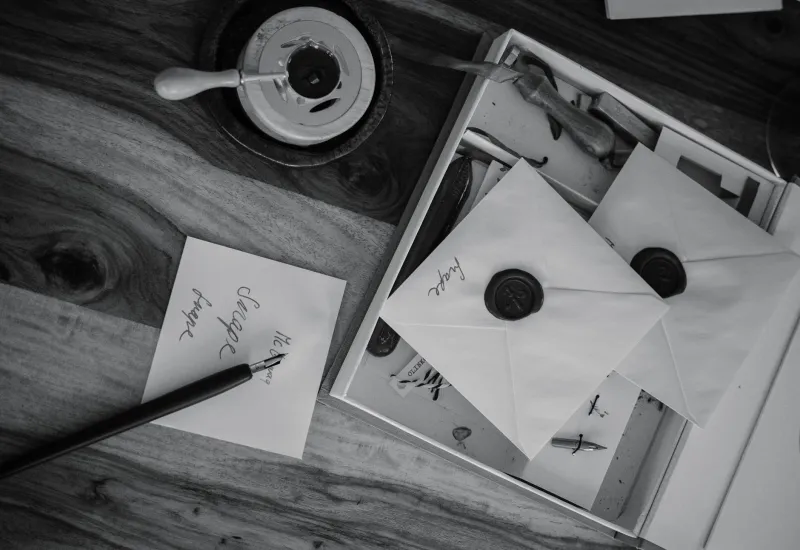
There's a small apartment in Portland, Oregon, where a 24-year-old named Dani keeps a wooden crate under her bed. Inside: stacks of unlined paper, a half-dozen ink pens, a collection of wax seals she's carved herself, and somewhere north of 200 letters — sent and received — from people she's never met face-to-face. Some are from climate organizers in rural Montana. Some are from mutual aid coordinators in Detroit. One is from a queer teenager in rural Mississippi who found Dani's address through a zine.
"I know what's in every one of those letters," Dani says. "I can't say the same about my DMs."
This is the slow mail movement — and it's weirder, more deliberate, and more politically charged than the aesthetic of vintage stationery might suggest.
Not Nostalgia. Infrastructure.
Let's get something out of the way: this isn't about cottagecore. It's not about washi tape and fountain pens as a vibe. The people building these postal networks aren't romanticizing the past — they're making a calculated decision about where their words live and who can access them.
The United States Postal Service, for all its dysfunction and budget battles, operates under a different legal framework than your email provider. First-class mail requires a warrant to open. Your Gmail does not. Your texts are backed up on servers. Your handwritten letter, once delivered, exists only in the hands of the person you sent it to.
That distinction matters more than ever to a generation that grew up watching Edward Snowden testify and reading headlines about data brokers selling location history to political campaigns. When you type something into any major platform — even a "private" message — you are, functionally, handing it to a corporation whose business model depends on knowing everything about you.
A letter in an envelope? That's just paper. And paper doesn't have a terms-of-service agreement.
The Network Behind the Envelope
What makes the current moment different from your grandma writing to her pen pal isn't just the politics — it's the architecture. Participants in these networks aren't just exchanging personal letters. They're building intentional forwarding chains, rotating addresses, and shared P.O. boxes that function almost like a distributed mail system operating inside the existing postal infrastructure.
Some groups use what they call "relay addresses" — trusted individuals in different cities who receive letters and forward them onward, obscuring the origin point of sensitive correspondence. Others circulate physical address lists through zines or in-person at events, keeping the network off any searchable platform entirely.
"We don't have a website," says Marcus, a 27-year-old community organizer based in Chicago who helps coordinate one such network across the Midwest. "That's kind of the point. If you can find us by Googling, we've already made a mistake."
Marcus got into slow mail after his activist group's Signal thread was screenshotted and shared publicly during a local organizing dispute. "It didn't come from outside surveillance. It came from inside the group. And I thought — what's the one medium where you can't just screenshot something and blast it to everyone?"
The answer, obviously, was paper.
Writing Slowly as a Radical Discipline
There's something else happening in these networks beyond operational security, though. Participants talk about the act of writing itself as transformative — not in a woo-woo way, but in a genuinely practical sense.
When you write a letter by hand, you can't fire it off in a moment of rage. You can't dash off a reactive paragraph and hit send before you've thought it through. The physical slowness of the medium enforces a kind of intentionality that digital communication has nearly eliminated from public life.
"I write differently when I write by hand," says Yolanda, a 22-year-old student and housing rights activist in Philadelphia. "I think more. I say what I actually mean instead of what's going to get the most response. There's no algorithm rewarding me for being inflammatory."
That last part is crucial. Every major digital platform is, at its core, an engagement optimization machine. The content that spreads is the content that provokes the strongest reaction — outrage, fear, tribalism. Correspondence through the mail exists entirely outside that incentive structure. Nobody's letter goes viral. Nobody gets ratio'd. The feedback loop is measured in weeks, not seconds.
For people doing the slow, grinding work of political organizing — building coalitions, maintaining relationships across distance, sustaining movements through the boring middle parts — that friction isn't a bug. It's a feature.
The Zine Pipeline and the Address Exchange
The slow mail world doesn't exist in complete isolation from digital spaces — it just uses them differently. Many participants find their initial connections through zine fests, mutual aid networks, or low-key posts in small online communities. But the moment a relationship moves to paper, it steps out of the algorithmic stream.
There are also dedicated address exchanges — physical directories, sometimes photocopied and stapled, sometimes hand-typed — that circulate through trusted channels and list people who want to receive letters. Think of it as a pen pal network with a political consciousness baked in.
Some of these directories are organized thematically: disability justice, tenant organizing, queer rural life, prison abolition. Others are purely geographic — people in a specific region who want to build slow, durable connections with others nearby without relying on a Facebook group that can be surveilled, reported, or simply shut down.
"Facebook groups disappear," Dani points out. "Servers go down. Platforms get bought. My letters are in a box under my bed. Nobody can take that from me."
What Gets Said on Paper
Ask anyone in these networks what surprises them most about the correspondence they receive, and the answer is almost always the same: the depth.
Without the performance pressure of a public or semi-public digital space, people write differently. They're more vulnerable. More specific. Less concerned with how they're coming across and more focused on actually communicating. Letters arrive that are funny and strange and raw in ways that a tweet or an Instagram caption simply cannot be.
"Someone sent me a letter that was mostly about their cat and then, in the last paragraph, said something about grief that I've been thinking about for six months," Yolanda says. "That doesn't happen in a comment section."
That intimacy isn't incidental — it's the whole point. In a media environment engineered to keep you anxious, distracted, and performing, a handwritten letter is an act of genuine presence. Someone sat down, thought about you specifically, and put words on paper. That's not a notification. That's a relationship.
The Stamp as a Symbol
None of this means the slow mail movement is going to replace Signal or take down Meta. It's not trying to. What it represents is something more modest and, in some ways, more durable: the insistence that some forms of human connection are worth protecting from the machinery of surveillance capitalism, even if that means accepting inconvenience.
A stamp costs less than a dollar. Paper is everywhere. And the act of sealing an envelope and dropping it in a blue USPS box on a street corner is, in its own quiet way, a declaration — that your words belong to you, that your relationships are not data points, and that the slowest form of communication still available to most Americans is also, sometimes, the most honest one.
The algorithm can't optimize a handwritten letter. And for a growing number of people, that's exactly the point.